
Flyers remain effective and relevant despite the prevalence of digital communications. Not only do these printed marketing materials offer a personal and tangible connection with readers, but they also deliver a highly focused message that’s different from online media’s information overload.
Particularly effective for local businesses and event organizers, flyers are cost-effective and highly customizable marketing assets. They are available in various sizes, laminations, and cardstock options, with the right choice depending on the design, distribution method, and visual brand identity.
Some people confuse flyers with brochures, thinking these two printed marketing materials are the same. In simpler terms, flyers are single-sheet documents designed for quick and broad promotions that target a general audience (e.g., passersby), while brochures are multi-page promotional prints that provide more detailed information to a focused audience (e.g., trade show attendees).
4 Standard Flyer Sizes
When designing your flyers, one of the most important things to decide on is the size. Your choice will depend on the design (especially the amount of information included), the distribution method, and the goal of your marketing campaign.
Although custom sizes may offer more creative freedom, sticking to standard sizes has certain advantages, like enhanced readability and easy distribution.
6 Common Cardstock Options for Flyers
Flyers are available in different cardstock options to accommodate varying budgets, durability needs, intended use, and the desired visual and tactile experience.
In the printing industry, there are generally two ways to measure paper or cardstock: points (pt.) and pounds (lb.). Pt. refers to the paper’s thickness in points (for example, 1 pt. is equal to 0.001 inches), while lb. pertains to paper weight in pounds.
- 70 lb. Paper – A thin but durable paper that’s easy to fold and hand out
- 80 lb. Paper – Carries a slightly heavier weight and thickness than the 70 lb. paper
- 100 lb. Paper – Has the same thickness, texture, and rigidity as premium magazine paper; it can be folded and sent out in the mail.
- 10 pt. Cardstock – A durable and lightweight cardstock that’s easy to carry around and hand out
- 14 pt. Cardstock – A sturdy cardstock that does not easily bend
- 16 pt. Cardstock – Has a slightly heavier weight and thickness compared to the 14 pt. cardstock, making it more resistant to creases
You cannot convert pt. into lb. (and vice versa) without knowing the paper’s specific type since it comes in varying sizes and densities. In general, a higher point in thickness or more weight indicates a thicker, heavier, and more durable cardstock.
Thicker and heavier cardstock provides a premium feel and look, making it ideal for high-quality campaigns. Its extra durability also makes it suitable for flyers or other printed materials that are meant for heavy use and frequent handling.
By contrast, lighter and thinner cardstock is more economical and thus suits flyers for mass distribution. It’s also ideal for designs that require folding.
4 Popular Lamination Options for Flyers
Flyers are available in various lamination options, such as gloss, high gloss UV, matte, and silk. The ideal choice depends on several factors, including design, purpose, brand image, and desired visual effects.
Gloss
- Considered the standard coating, it offers moderate shine.
- Ideal for projects needing a step up in shine and durability from uncoated paper.
High Gloss UV
- Creates a mirror-like shine and offers greater durability and protection against wear and tear compared to a standard gloss coating. It also gives a high gloss shiny finish that will make your image “pop.” You may not be able to write or imprint on this coating.
- Ideal for flyers that need to stand out or require extra protection.
Matte
- It creates a flat, non-reflective surface, making the colors appear more subdued.
- Ideal for text-heavy flyers where readability is a priority. Also suitable for minimalist and elegant design.
Silk
- It has a smooth, silky, and subtle tactile quality, similar to high-end fabric. It also creates a non-reflective surface.
- Suitable for premium flyers
How to Design an Effective Flyer
Designing a flyer may not be inherently difficult; however, creating an eye-catching and effective one that resonates with your audience is the real challenge. The goal is to convey a single clear message by combining text that converts and design that dazzles readers.
Check out this step-by-step guide on how to design flyers that people actually want to read.
Choose a focal point.
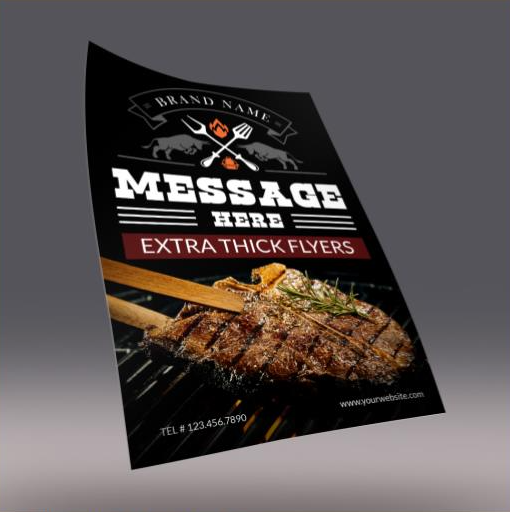
Your focal point can be a visually striking image or a catchy and easy-to-read text. Your choice will depend on the primary message (or main purpose) of a flyer.
To make sure the main image or text takes center stage, avoid adding graphic embellishments that will only create visual clutter.
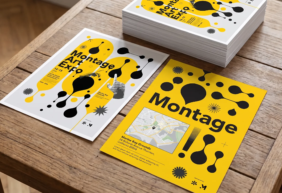
The flyer template below is a great example of how to use a visually striking image as a focal point.
Keep the content and message simple.
When your flyer marketing campaign has a well-established goal or purpose, it’s easier to keep the content and message simple. Alternatively, you can also focus on the benefits you offer to the reader to craft an impactful message.
KD Macalinao, art director of Digital Media at Digital Room, said you won’t go wrong if you follow the design principle of “less is more,” which leads to better comprehension and readability.
Consider your target audience.
Knowing your target audience will help you design flyers with content, tone, and style that resonate with them, thereby increasing your campaign’s effectiveness and engagement.
Include a call-to-action.
Your flyer should always include a CTA (e.g., call now, visit us, or sign up) to guide users to take a specific action. The idea is to get them excited about your message, and ultimately, to increase conversions and achieve your marketing goals.
Also, be clear about how you want the reader to interact with you by including important details about your business, like your website, contact information, and address.
Consider using a design template.
Although you can design your business flyers from scratch, using pre-made templates offers benefits. You can customize the layouts, fonts, colors, images, and other design elements to make the final design consistent with your brand.
If you need pre-made templates, NextDayFlyers offers them as part of their free, complimentary service.
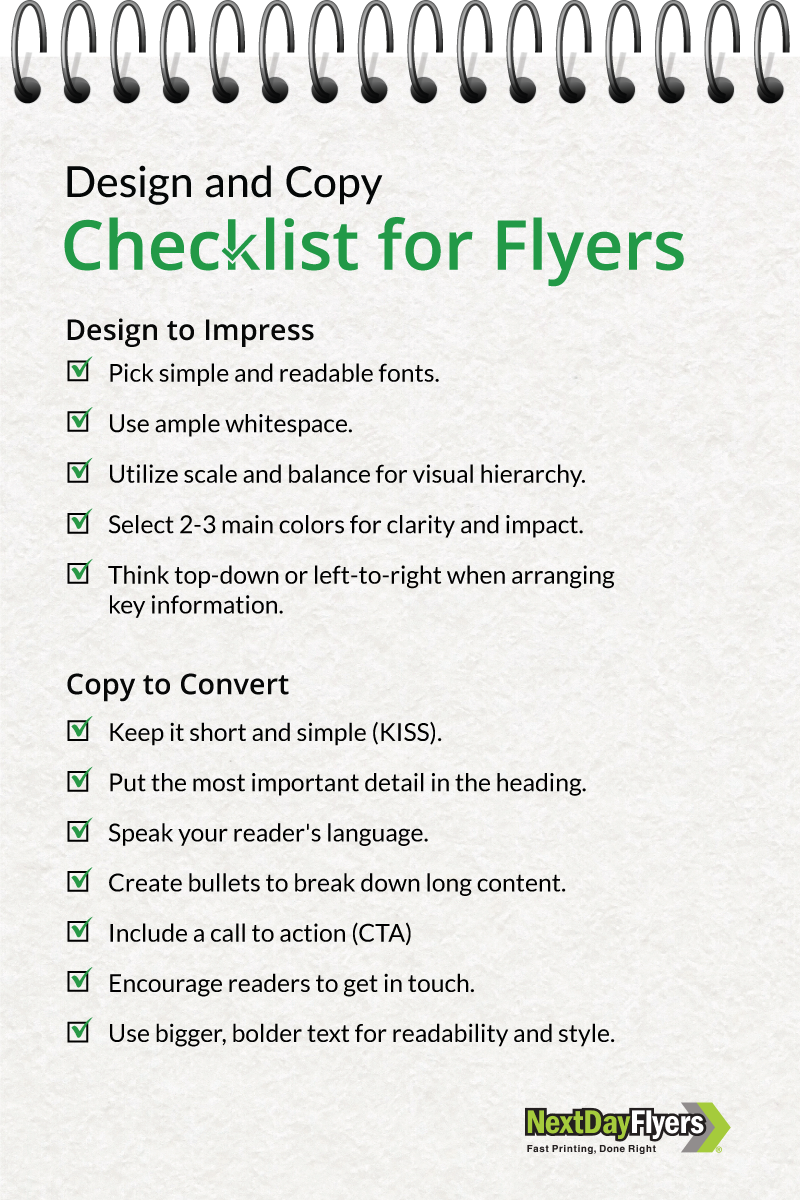
Check out this free flyer design checklist to make sure you won’t miss anything important.
Different Ways to Distribute Flyers
Knowing what constitutes an impactful and effective flyer design is just half the battle. Your distribution strategy will also play a crucial role in the success of your marketing campaign. Check out the recommended strategies below and decide which of these apply to you.
High-Foot Traffic Areas
When handing out flyers, you want to reach as many potential customers as possible. One great way is to choose spots where lots of people walk by every day, such as street corners, downtown business districts, and public transportation hubs. Additionally, pick times when these places are busiest, like lunchtime or early evening.
Always ask for permission if you’re giving out flyers inside private or business places.
Trade Shows
You can keep a stack of flyers at your booth or hand them out at trade shows. Event attendees are often perceived as a focused audience (i.e., they tend to have a high purchase intent, or they are already familiar with your product or service). With this consideration in mind, you may want to design your flyers in a way that includes more detailed information.
Community Events
Weekend farmers’ markets, community fairs, sports games, and festivals present an excellent opportunity to hand out flyers.
Reach out to event organizers to ask if you can set up a small booth or hand out flyers to attendees or visitors.
Local Businesses
Working with other local businesses can help you reach more people. If your brand aligns with what they offer, they might let you leave a stack of flyers in their shop, especially if you’re also willing to display their flyers or promote them in your store.
Depending on the type of business you have, your potential partners may include coffee shops, salons, fitness centers, hotels, specialty stores, and clinics.
Residential Neighborhoods
If your business offers a service for local people — like cleaning, gardening, or food delivery — you can use direct mail marketing or hand out flyers directly to homes. Just make sure you follow the local rules about flyers to avoid fines and penalties.
Another option is to work with a local newspaper’s advertising department if you want to use flyers as “inserts.”
Community Boards
Places like community centers, churches, supermarkets, and public libraries often have bulletin boards where you can pin your flyer. Consider using any of the bigger standard sizes (such as 8.5″ x 11″) if you need to include more information.
People tend to stay a bit longer when reading bulletin board announcements, so you may want to choose a bigger flyer size with more details.
Ways to Save Money on Flyer Printing
Flyers can be a cost-effective marketing tool, especially for small businesses and event organizers, because they have low production costs. However, you can enjoy additional savings if you follow these tips:
- Choose professional printing. For large prints, having your flyers professionally printed is usually more cost-effective than DIY printing. Also, you will have more customization options.
- Buy in bulk. With large-volume orders, you pay less per unit. For example, ordering 25 pieces of 4″ x 9″ flyers may cost $2.72 per unit, but with 200 pieces, it may be as low as $0.91.
- Choose a longer printing turnaround time. There is a significant cost difference between a “three business day” turnaround time and a “ready today” shipment. In some cases, the price difference can be as high as 50-60 percent.
- Opt for smaller and lighter paper stock (if applicable). If you need flyers for mass distribution and short-term campaigns, a lighter cardstock is usually a more cost-effective option.
Now that you know everything about flyers, including the various customization options, design tips, distribution methods, and money-saving tips, you can start your flyer marketing campaign with more confidence.
If you’re concerned about the layout and color accuracy of the final print, you may request a digital proof from NextDayFlyers. We offer this free service to allow you to review the design and catch errors (misspellings or color issues), so the final product meets your expectations.