

Key Takeaways:
- Many food businesses use standard menu sizes to balance excellent readability, professional presentation, and affordable printing.
- Most customers are familiar with standard menu sizes and using them for your food business can help give patrons a pleasant experience, from browsing options to placing orders.
- Using standard sizes makes it easy to align your menu with your existing marketing materials such as brochures and flyers.
Despite the prevalence of digital screens, printed menus remain critical in food businesses. These humble yet hardworking prints highlight special or high-margin items and offer customers a tangible, exciting browsing experience
Menus are available in various standard sizes, and the right size depends on several factors such as table space, brand and design requirements, the number of offerings, and budget. In this article, we discuss the most popular menu sizes so that you can pick the right match for your business’ needs.
Flat Menus vs. Folded Menus
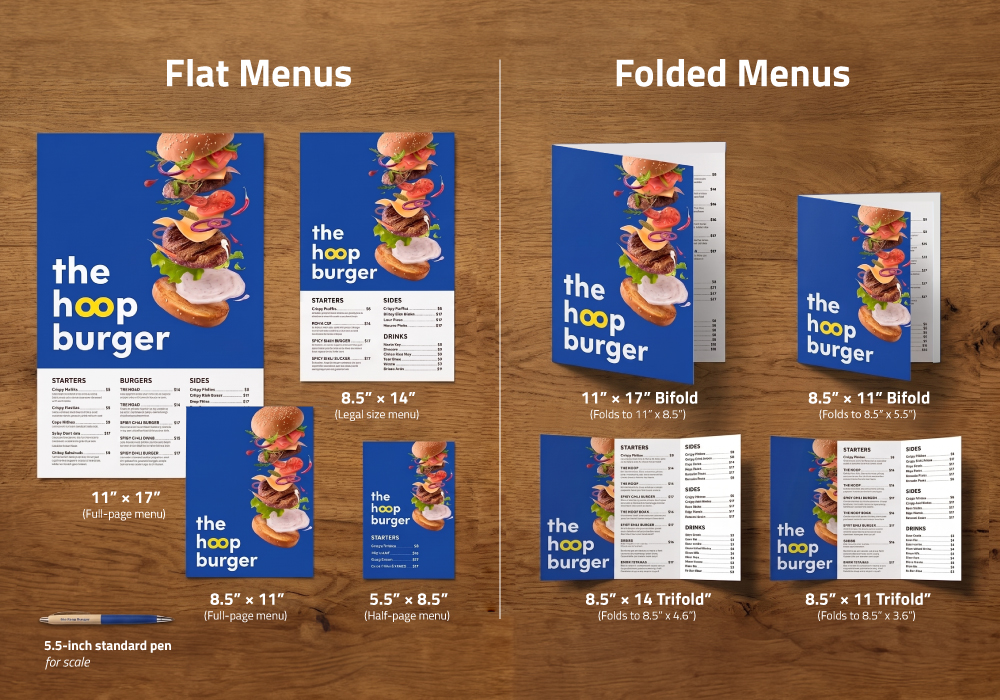
Before we discuss standard menu sizes, it’s important to know the difference between flat menus and folded menus. The right choice primarily depends on how extensive your food and beverage selections are.
A flat menu has a single, unfolded sheet, and is typically printed on both sides. This option is ideal for small cafes, fast-food chains, quick-service restaurants, takeaway menus, and specials.
Meanwhile, a folded menu has multiple panels or sections created by folding a single sheet of paper. The panels make it easier for restaurants with a big menu to organize their appetizers, main courses, beverages, specials, and kids’ menu.
Common Flat Menu Sizes
Small cafes and restaurants with limited or simple selections typically use flat menus printed on both sides. They are easy to hand to customers and are affordable to print, making them ideal for businesses that frequently update their menus.
Restaurants and cafes with a wide variety of options also use flat menus to highlight seasonal dishes, specials, and kids’ menus and then tuck them into folded “main” menus.
Popular sizes include 5.5″ x 8.25″ (half-page) and 8.5″ x 11″ (full-page). Extra-long menus, such as 8.5” × 14” and 11″ x 17″ are also commonly used for casual settings.
Benefits:
- Affordable and easy to reprint
- Great for specials and seasonal items
- Easy to hand out to customers
Best for:
- Small menus
- Daily specials
- Food trucks
- Small cafes
- Quick-service restaurants
Design Tips:
To encourage more orders and set clear expectations, use high-quality, mouth-watering food photos. Additionally, divide categories using white space instead of boxes to reduce clutter and improve readability.
Common Folded Menu Sizes
Folded menus are often available in bifold and trifold styles, creating multiple panels or sections you can use to arrange food items by category (appetizers, main courses, desserts, etc.).
Bifold menus are created by folding a single sheet in half, yielding four panels. They’re available in two standard sizes: 8.5″ x 11″ (folds to 8.5″ x 5.5″) and 11″ x 17″ (folds to 11″ x 8.5″).
On the other hand, trifold menus are folded into six panels, a classic design favored by restaurants that offer an extensive selection of food items and beverages.
Folded menus often cost more than flat menus, so they typically suit restaurants, bars, and cafes that rarely change their menus.
Benefits:
- Clear sections for food categories, beverages, and a few specials
- Compact and easy to hand out
- Professional look without the clutter
Best for:
Restaurants with extensive menus, usually diners, family restaurants, and cafes with a wide selection of bread and pastries
Design Tips:
Group related items in a logical, familiar order. Folded menus typically follow this sequence: appetizers or starters, soups and salads, main courses, side dishes, desserts, and beverages.
Additionally, place high-profit or featured items on the center panel or the first section to make them highly visible, and put the most expensive choices at the top of each category to make other selections seem more reasonably priced.
How to Pick the Right Menu Size: Factors to Consider
Each business has its own unique needs. Here are the factors you should consider when deciding on the size of your menu.
Restaurant Concept
Fine dining restaurants typically use a large flat or folded menu to present their main selections and smaller flat menus for their specials, beverages, or desserts. On the other hand, cocktail bars and cafes often use compact sizes, like 4.25″ x 11″, for their “main” menus.
Number of items
Cafes and food trucks typically have limited or hyper-focused menus, so they often require smaller sizes, while family restaurants generally have more diverse offerings that are suitable for large, multi-panel menus.
Readability and User Experience
The “best” menu size provides enough space for legible text, visually striking photos, and white space to “divide” categories (e.g., appetizers, mains, and desserts) and create a logical flow.
Handling and Storage
When deciding on the menu size, always consider your operational aspects, such as how you store the menus, display them, and hand them to your customers. The layout and dimension should be practical for your daily operations.
When to Use Custom Menu Sizes
Although using standard menu sizes is a practical choice for many businesses, in some situations, custom-sized menus might be a better option because of these reasons:
Best for:
- Strong Branding: You need menus with a unique shape or dimension to reflect your restaurant’s brand personality.
- Fine Dining: If you want to distinguish your business from casual restaurants, you may need menus with a unique dimension or layout.
- Special Events: If your restaurant hosts intimate events like weddings and anniversaries, consider using custom-sized menus.
- Focused Offerings: A long and narrow menu (e.g., 4.25″ x 11″) works well for drink lists, while an extra-wide menu suits a comprehensive fare.
- Highlighting Specials: A smaller custom menu (e.g., 5.5″ x 8.5″) can draw attention to the kids’ menu or seasonal offers.
Choosing the right menu size ensures an easy-to-navigate format and excellent readability, enhancing your customers’ dining experience. The “best” dimension also has enough space for all the key details, including food photos, text descriptions, and branding elements.
If you need menus for dine-in or takeout, NextDayFlyers offers a wide range of customization options, including a waterproof finish, premium cardstock, and multi-panel designs.
Use a free menu template from NextDayFlyers’ selection to get your custom menu printing started.